I don’t know how it happened, but I have always loved writing. I was never at a lack for something to say, and I loved sharing my imagination with others. I have a good visual-spatial sense, so drawing and writing came naturally to me. My fingers and brain cooperated, and I was able to put down on paper an approximation of what was in my mind. I thought everyone experienced drawing and writing in this way until I became a teacher.
I started my teaching career in early childhood education working with three- and four-year-olds. Young children are intrepid. They dart here and there, jab paper with crayons and pencils, and can tell you a fifteen-minute story from the squiggles on their page. The story changes every time they show you their paper, but that does not discourage them. It is natural for them to revise the story as they go along.
Unfortunately, something changes when we teach kids to write formally. Suddenly, there are ALL these rules! And you must REMEMBER them! Now, it becomes difficult work: letter names, letter formation, spelling words, spacing, making sentences, capitalization, and punctuation all wrapped up together to show that you have something to say. Once you have written, you must make sure your story is in the right sequence and has descriptive details. Can your reader understand what you have written? It is a tall order for a five-year-old child, and we have high expectations for how they must be writing by the end of each school year.
I have been thinking a lot about writing and especially about the children who find writing to be daunting. For me, writing sometimes feels truly impossible. Over the years, I have tried all kinds of strategies with reluctant writers knowing that motivation and interest are two very important factors. Without interest and motivation, it is hard to plow through all the difficult tasks writing requires. I know to get good at anything, you must put time into it. “Practice makes permanent,” as the saying goes. Recently, I read David Sibley refer to his development in drawings birds as “putting in pencil miles.,” which is a term used by nature journalist to describe the practice that goes into honing their craft. That vivid image made me think of all the pencil miles I personally have put in in regard to writing poems and prose. And I know as I’ve coached children over the decades, it is the putting in of pencil miles that has made all the difference. Of course, practicing and putting in all those pencil miles is hard work, so we must find ways to make writing enjoyable.
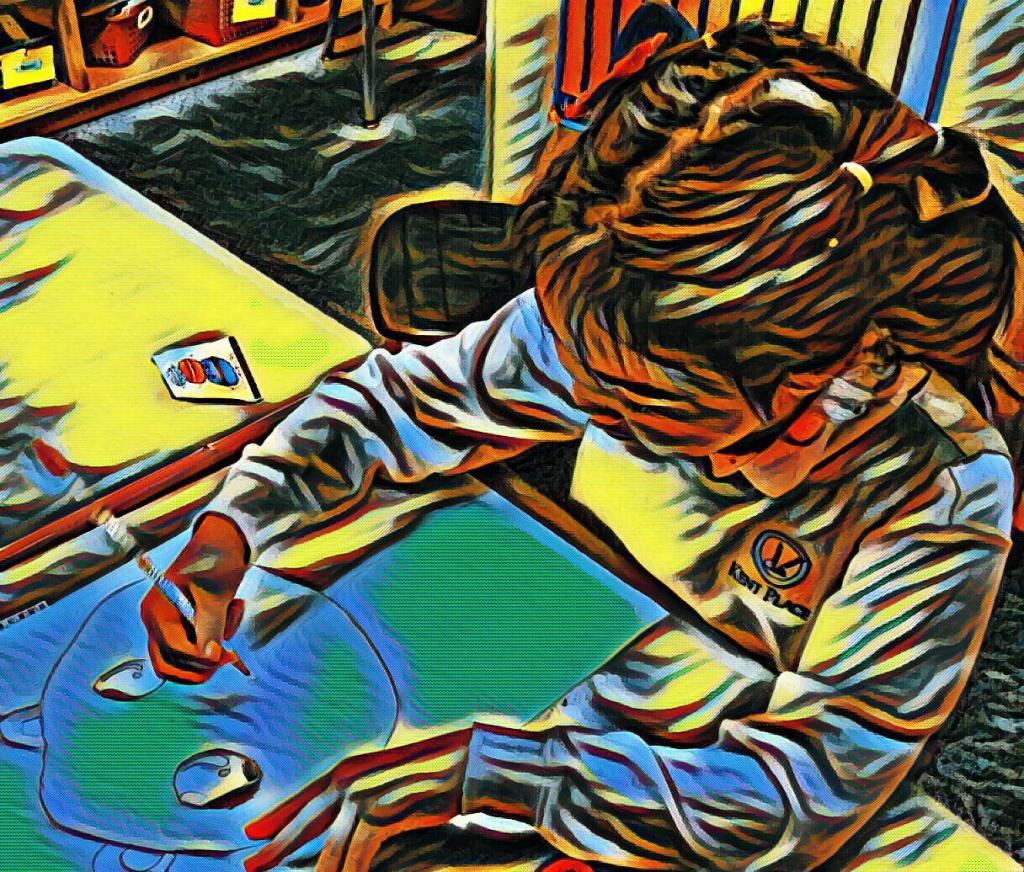
This week, I had two opportunities to sit down and write with children. The first encounter was in a 1st grade classroom where I was invited by the teacher to help during writing time. The children were asked to write how they could be a “true blue” friend. The teacher distributed a cutout of a blue person on which the children could write their ideas, as I settled myself at a small table at the back of the room. I feel comfortable in this setting. This is my territory. Soon, I called two students to come to the table to write. They shared what they were going to write. We talked about ways to be good friend, and they started to write. As I watched, I realized what a slow process this was for beginning writers. They were sounding out words aloud. They were putting their fingers down between words to make sure there was proper spacing, and they were stopping to erase and correct mistakes as they went along. They were a tenacious duo. Soon, I had four students at the table with me, and then I had six – all eager to share their ideas and write. Little voices telling me what they were going to write: friends are helpful, they play games together, they share candy, they laugh together, friends hug you when you cry. The ideas came easy. The writing was harder. Spelling was harder still. But the children persevered and completed their sentences.
The next opportunity I had to sit down and write with children came later in the week when I offered an after-school class on the Art of Story, which is a combination of writing and drawing -making books and creating graphic stories. Six children signed up: five 2nd graders and one 5th grader. I wasn’t sure how it was going to go – whether I could engage them for an hour. Did they had the stamina to write and draw? I set out material: new sketchbooks, fresh pencils, colorful kneaded erasers, extra paper, and black flair pens. When the girls entered the sunny classroom, the material was waiting for them with this prompt written on the board. Create a character from the initial of your first name. After you have drawn your character think about what he/she likes to do and tell a story with pictures and words. The girls opened their notebooks and immediately started drawing. I sat down and told them that I would draw/write alongside them. As we worked, it felt like gathering around a kitchen table rather than classroom desks. The girls showed each other their drawings, asked for help with spelling, and shared their story details. They looked over at what I was doing but didn’t copy me. I was one of them, and they were confidently making their own stories. At one point, I paused, put down my pencil, and wondered aloud how I could end my story, several girls gave me suggestions. They gave me drawing suggestions too. There was an easy exchange of ideas throughout our time together. The older student felt comfortable with the younger ones, the younger ones diligently worked and created their stories until I signaled that it was time to clean up. Carving out this time in the week to write and to write with a group of children is very restorative. I know it’s restorative for me, and I think it’s also restorative for them. It is a time to write just for oneself. There is no judgment or grading, just a community of writers and stories. Stories are what every person on this planet yearns to tell and share – their experiences, their ideas, and their unlimited imaginations.
 Word Dancer: Literature, the Arts, & Education
I read this on Monday to feel hopeful! You certainly delivered that feeling indeed. I love the, “putting in the pencil miles,” but that is only the beginning. Making writing like a club, an activity that is worthwhile both with the first graders, “Soon, I had four students at the table with me, and then I had six – all eager to share their ideas and write,” and the Art of Story group. “Restorative” embodied. I feel that way after merely reading about these interactions. ❤️
LikeLiked by 1 person