
I have been teaching for two-thirds of my life, and I am now looking back over those years and thinking about how we learn and what makes some of us life-long learners. I am especially interested in how some people love to read and some do not. I can’t imagine my life without stories. Since before I could formally read, I loved to listen to stories. I loved to watch strangers and make up stories about their lives. I loved to look at pictures and put myself in the middle of the scene. I was primed for wonder. I loved to dream and think about the “what if’s.”
When I was an early elementary teacher, I became acquainted with David Wiesner. He is a brilliant children’s book writer and illustrator. His art tells amazing stories that keep his readers wondering and more and more curious. His subjects are a bit zany, which piqued my students’ interest and kept them wanting to hear more.
One book of Wiesner’s that I really loved was June 29, 1999, which is amazingly 25 years ago! This book weaves a fascinating story about a young student, Holly Evans, who launches a science experiment with surprising results. I thought the book would be perfect to teach kids about how to generate questions while reading. Certainly, Wiesner’s stories make people think, wonder, and question.
I told my students that they would be practicing their questioning skills using the book, June 29, 1999. I proceeded to read the story aloud, and modeled my thinking by generating some questions for the first couple of pages. Then, I asked students to think about questions they had as I kept reading and showing the pictures. I gave them a sheet of paper to record any questions and stopped periodically to give my students time to share their questions.

At the end of the read aloud, I asked students to reflect on three key questions:
- Does David Wiesner answer all our questions?
- Why do you think he ended his book the way he did?
- What questions do you still have about the events and characters?
I wanted the students to understand that questioning is an essential part of learning. The more questions you have, the more you will learn.
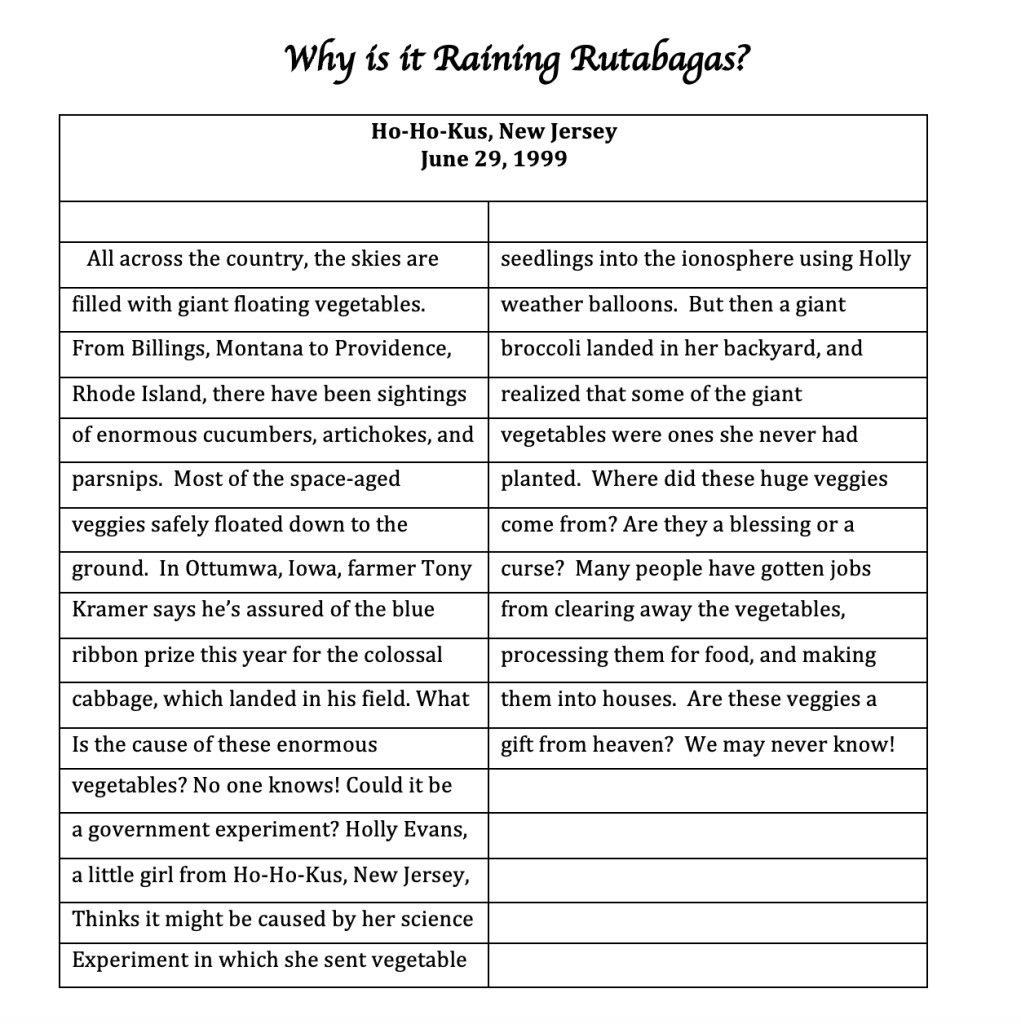
After I had read the story and the students had time to think about their questions, I asked them to write a news article about the events in June 29, 1999. First, they had to think of a question and use it as their headline. They retold the story choosing major events and shared their articles with their classmates. Below is a sample story I wrote.
If you want a fun and thought-provoking way to start the new school year, I highly recommend exploring wonder with the work of David Wiesner!
Wonder-Filled Books by David Wiesner
 Word Dancer: Literature, the Arts, & Education
This is fascinating. Thank you, I will forward your post to my daughter. Her children will be interested. Regards, Lakshmi
LikeLiked by 1 person
I agree that questions and wondering should be a part of daily learning in life and in the classroom.
LikeLiked by 1 person
Wow! I really enjoyed this post. Sounds like a wonderful book and an excellent lesson to help students pay attention to the questions in their mind. This week, I will hunt down that book and use your ideas with a student that I tutor. Thanks so much!
LikeLiked by 2 people
Here’s the comment I tried to post but could not:
*I loved to dream and think about the “what if’s.” *
I did this too when I was a kid. In fact, I still do it. I imagine myself in different paces, experiencing different cultures. I don’t know this writer, but I love the way you invite students to question. It’s so much better than looking for right and wrong answers. Glenda
On Sun, Jul 7, 2024 at 6:41 PM Word Dancer: Literature, the Arts, & Educati
LikeLiked by 1 person
Joanne, I enjoyed reading the process you used with your students to teach questioning. It seems like such an effective lesson! I have had some good experience with David Wiesner’s books, especially the more famous ones like Flotsam and Tuesday. The newspaper article based on this book was a great way to synthesize the story. I love the theme of wonder here.
LikeLiked by 1 person