This week, while I was pondering what to blog about, my cousin Tina sent me a link to an article adding the note: “If you have time, I know you will enjoy this article. It is about gratitude, gift economies, and nature – plus so much more. It’s a longer read, but definitely worth it.” Tina always steers me in the right direction. We have so much in common – teaching, writing, art, nature, and wanting to give back to our communities.
I immediately started reading “Returning the Gift” by Robin Wall Kimmerer, the author of Braiding Sweetgrass: Indigenous Wisdom, Scientific Knowledge and the Teachings of Plants. She is also a member of the Citizen Potawatomi Nation. Kimmerer noted that in today’s modern world we often miss Earth’s gifts and need to pay closer attention to truly feel part of her to adequately protect her. Kimmerer recounts the creation story from the Onondaga people. I know this myth as Earth on Turtle’s Back from a visiting Native American storyteller. When I taught 3rd grade at the Dalton School in New York City over twenty years ago, I rewrote the story into a play giving all my students speaking roles, which we performed for the school. So of course, Tina was right. I did enjoy the article, and it sparked so many connections.
A fact that I knew but am still amazed by was Kimmerer’s observation that: “Today the average American schoolchild can recognize more than a hundred corporate logos. They can give a name to about ten plants, and these include such categories as “Christmas Tree” and “Grass.” We have lost an entire vocabulary, of speech, of experience, and of relationship. Our fundamental currency of relationship, our highly evolved capacity for paying attention to those species who sustain us, has been subverted in a kind of intellectual hijacking. How can we care for them, monitor their well-being, and fight for their existence if we don’t even know their names?” The year I began teaching at Dalton, I had come from teaching 2nd Grade at a suburban New Jersey private school whose campus was along the Raritan River. The river became our teacher and much of our social studies and science lessons came from the land around us. The school building was an old Dutch farmhouse, and we explored every inch of the property: collecting plants, studying insects, and taking water from the river to put into our aquarium. We soon noticed the water was teeming with tadpoles who soon turned into frogs, except for one large fellow. He took more time to develop, and eventually, to our surprise and delight, he became a toad.
I wanted to give my city students what my suburban students had – a connection to nature. Dalton is located only a few blocks from Central Park, so I was able to take my students into “nature” every week. We took long walks, adopted trees to watch throughout the seasons, and sketched the beauty of the park. Early in the fall, I asked the children to go on a scavenger hunt. On the list were items from nature: a branch, a stone, an acorn, an oak leaf, a pinecone, maple seeds, etc. As the children scattered across a small portion of the park, I watched them happily filled their brown paper bags. Soon, they were running back to me with questions: “What is an acorn?” Or while holding up a Maple seed (samara) asked, “What is this?” I was astonished that they were not familiar with these things that my suburban kids had known since they were toddlers. So, I intentionally gave them opportunities throughout the year to be in nature. We learned about city trees and birds and created a windowsill garden in our classroom. On the last day of school, I received a letter from the mother of one of my students. It was a thank you letter. Now, I’ve received many thank you letters, but this one I’ve tucked away for almost 30 years. This letter said, “Thank you for teaching Zach to climb a tree. He would have never had the confidence to that without your encouragement. Thanks to you he is developing a profound love for nature.” I smiled when I read it because it was then that I knew that I had been successful. I had given city kids a taste of nature and an appreciation for all living things. I deeply agree with Robin Kimmerer when she writes, “We are surrounded by teachers and mentors who come dressed in foliage, fur, and feathers. There is comfort in their presence and guidance in their lessons.”
I went back to Tina’s original text to find the link to the article. I laughed when I saw that she had intended for me to read an entirely different article by Kimmerer – “The Service Berry.” Well, that means I have more reading ahead of me. And more time to think about all the gifts Mother Earth has bestowed on us. Truly, I agree with Kimmerer that to properly care for Mother Earth, we must feel our connection to her. We must pay attention, observe the wonders all around us, and remain grateful.

 Word Dancer: Literature, the Arts, & Education
Do you know about the National Writing Project’s Write Out? https://writeout.nwp.org/
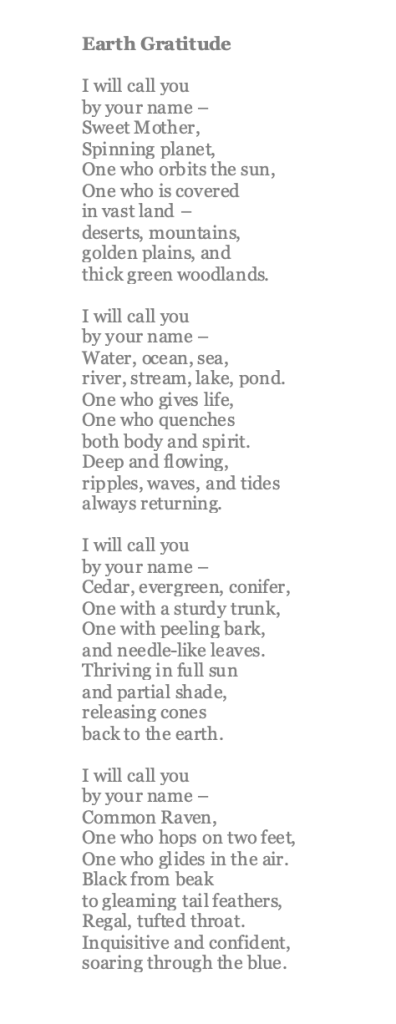
I am working with my colleagues on creating a day in the park where the students rotate to different writing and discovery stations. I hope it all comes together. I think most children do not spend enough time outside. And being outside lends itself to writing about it. Lovely poem.
LikeLiked by 1 person
I was going to mention the Write Out, but Margaret beat me to it. No worries, though; you are way ahead of most in giving the gifts of observation, participation, and appreciation to your students in their relationship with our natural world. There is a really terrific TED talk that I love. If you haven’t seen it, I think you might enjoy it, too. This is a wondrous post. Thanks so much.
LikeLiked by 1 person
Thanks! I will watch the TED Talk!
LikeLike
Love this post– you had me with the reflection about logos and plants. Yes, a whole vocabulary lost… I loved the toad, the tree-climbing, the poem, the teachers in fur, foliage, and feathers, and I loved the fact that you have a whole other article still to read. Maybe it will be another blog post, but I doubt one that impacts me as much!
LikeLiked by 1 person
Joanne,
I really love Braiding Sweetgrass and its impact on how I move in the world. Knowing so many children don’t experience nature is tragic. That’s not something we see much here in Idaho where being outside is inherent to lifestyle. All kids deserve time in nature. And I love your poem.
LikeLiked by 1 person