It’s February. My part of the world is dingy white and oh so cold. This frigid weather gives me time to pause, time to sit somewhere cozy with a warm drink and make my pen wander down the page. Recently, I attended a Zoom book talk presented by John Schu and Jennifer LeGarde (AKA Library Girl). They are a wonderful resource for new picture books, chapter books, and YA fiction. John’s choices never fail to hit the heart. I also find so many good book choices from colleagues, writing group members, and my fellow bloggers. One book that keeps being mentioned is the picture book Broken by X. Fang. It’s about a young girl, Mei Mei, who accidentally breaks her grandmother’s (ama’s) teacup. She doesn’t tell the truth at first, and lets her ama think that the cat had broken the cup. As a result, Mei Mei’s guilt eats away at her until she finally blurts out the truth. Instead of being angry, her ama repairs the cup, and all is forgiven and well with the world.
This is a perfect book for ethical conversations: Is it a lie if you don’t tell something you know happened? Why do you think the girl Does it matter that the girl broke the cup by accident rather than on purpose? Why does the truth sometimes feel scary? Can a relationship be fixed after it’s been broken? The book can also be used as a mentor text for writing about memory and strong emotions. When I read the book and thought about a memory of something broken, I immediately thought about a glass jar that held cigars tightly packed in concentric circles.
This jar was not something that I broke. No. But I can see it vividly even though this memory is close to 60 years old. I thought the glass container was so beautiful, encircled by a red satin ribbon, holding something my father enjoyed – cigars. When I saw it in the store, I knew I had to buy it for him for Father’s Day. I was so pleased with myself and knew he would be proud of me.
Yes – the beautiful cigar jar broke, but not by the tail of a wagging dog or a trip down the stairs. On Father’s Day, I handed my father the precious, wrapped gift. As he unwrapped it, his expression turned from joy to rage in a matter of seconds. And in those seconds, he threw the container against the wall, and it smashed to bits. My father was angry because I had chosen the wrong brand of cigars. Only years later would I find out that those cigars had triggered an old wartime memory for him.
As a twelve-year-old, all I knew was that my heart was broken, and it would take years for me to repair the damage of that moment. My present was destroyed. My relationship with my father was changed forever. I never trusted him again. I wanted to. I just couldn’t,t and that, I learned, was okay. I could forgive him, but I didn’t have to trust him. I could create something sturdy for myself.
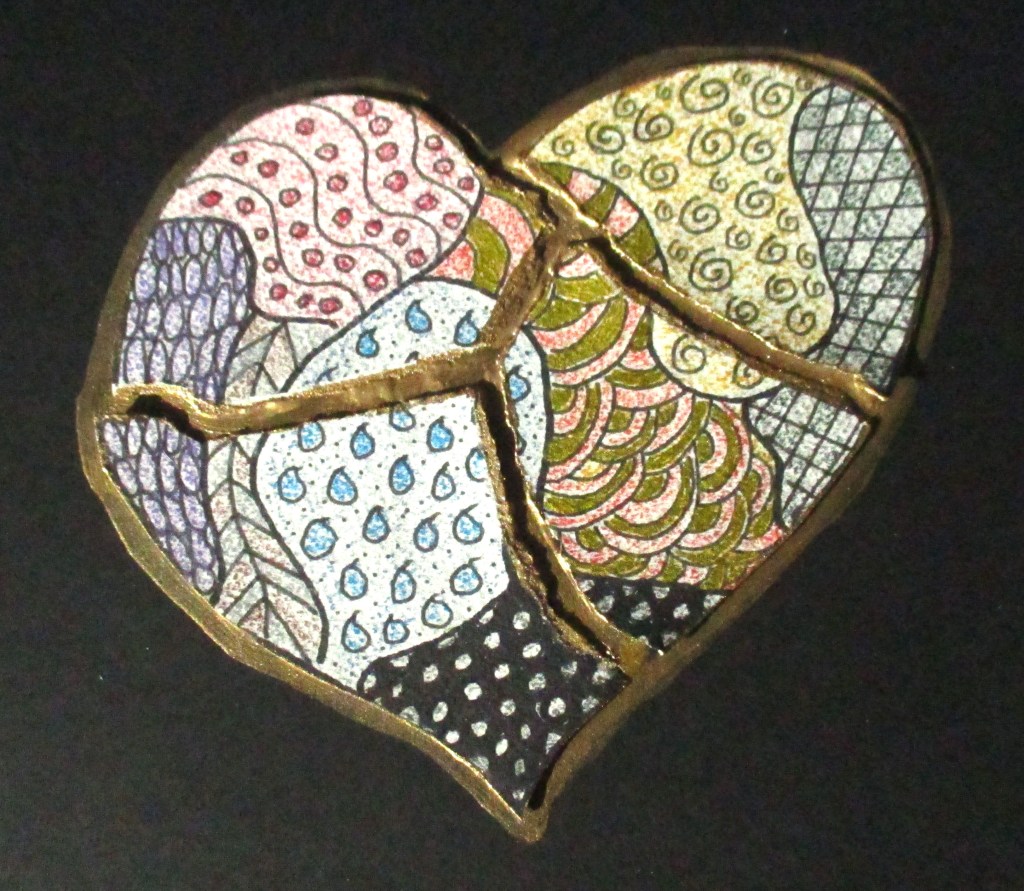
Several years ago, while reading A Novel Approachby Kate Roberts, I learned about the Japanese traditions of Kintsugi– mending broken pottery with gold to literally make the broken beautiful. Brokenness did not have to be discarded. I could be put back together better and stronger. Where once it had been torn or shattered, it could be revived, recreated, reimagined into something new. And this new version could be even more beautiful with all its scars and stitches showing.
That painful memory helped me grow stronger. Eventually, I knew I could be resilient, bounce back from anything this world might throw at me. I learned to be patient with myself. Slowly, I took all those things that my father thought were weaknesses: joy, kindness, tenderness, compassion, and stitched them into a beautiful armor. And yes, I can say that once I was broken, but I knew I wasn’t going to stay that way. I gathered all the shattered shards of my little-girl heart to make a life for myself that was not perfect but is tenaciously beautiful.
A Hundred Broken Pieces

I’m twelve and so excited.
It's the first time that I bought
 my dad and grandpa presents
with my own money
for Father’s Day.

Grandpa hugs me when
I give him a book about gardens.
He is a magical gardener.
I am so proud and proud of
the gift I chose my father.

It’s a beautiful glass decanter
filled with his favorite cigars.
I smile hopefully
as I watch him carefully
unwrap it and hold it in his hands.

I start to get close for a hug,
when suddenly he turns,
his face is red with rage –
These are not my favorite cigars!
I hate these! You are a stupid, stupid girl!”

His terrible hands throw the
beautiful glass against the wall.
My gift smashed into a hundred broken pieces.
I run away, out the door, into the car,
tears streaming down my face.

My grandfather comes out to sit with me
He tells me he is sorry,
tdoesn’t know what’s wrong with my father.
He says, “He used to be such a gentle boy.
He wrote beautiful poetry.”

My father doesn’t say a word to me,
and I don’t speak to him for days.
When he does speak, he says
“I shouldn’t have done that.”
No sorry, no hug, just those empty words.

I promise never to give him another present,
and I keep my vow for seven years.
Then buy "Leaves of Grass" by Whitman.
My dad sits silent with it in his hands
Hopefully poetry will heal him.
 Word Dancer: Literature, the Arts, & Education
This is probing such a tender memory; you are brave. It makes me think about several important ideas—guilt, the unknown hauntings that others keep hidden until they burst forth and damage someone who now has a similar hurt to carry, and the gold of repair. During a figure skating event at the Olympics, one of the skaters wore a costume that represented Kintsugi. These words echo: “I could forgive him, but I didn’t have to trust him.”
LikeLiked by 1 person
Thanks, Trish. I have to look for that costume!
LikeLike
This is a slice of life that seems so dark and sad until the very end. I can understand the sorrow that the child carried for so many years. Your prose provided thoughts for the poetry. Thank you for sharing your story.
LikeLiked by 1 person
This is a powerful tale of anger and brokenness and yet you have somehow crafted it into a memory of a turning point and the beginning of your self-empowered healing. It is beautifully written even if I wish it weren’t true. Thank you for sharing your story.
LikeLiked by 1 person
Wow, thanks for sharing this heartfelt piece of work. May it help others heal also.
LikeLike
I am so touched by your story. When I was a teenager and just trying out poetry, I read a poem to my dad. He criticized it. I held on to that for years, not writing, not feeling good enough. Fathers are complicated beings. Yours was especially damaged with a wound you could not understand. I’m happy you have come to forgiveness, but it takes a lifetime of work, doesn’t it?
LikeLiked by 1 person
Thank you, Margaret. Fathers are indeed complicated and it wasn’t until I was an adult what my dad went through during his time as a Marine in World War II.
LikeLike
Thank you for sharing. It happens to all of us that an incident brings backso many memories. Your father must have been so hurt during the war.
LikeLike