
This week, as we look forward to the 250th birthday of America, I want to reflect on an unlikely Revolutionary heroine, Phillis Wheatley. Her history is remarkable. Born in West Africa in 1753, she was brought on a slave ship, The Phillis, for which she was named. She was sold to the Wheatley family of Boston, who raised and educated her. Phillis learned English, Latin, and Greek and wrote her first poem at the age of fourteen. She published a collection of poetry called Poems on Various Subjects, Religious and Moral in 1773, making her the first enslaved person to publish a book.
One poem included in her book, written in 1772, is “To the Right Honourable William, Earl of Dartmouth.” The poem was written as a welcome to William Legge, who was recently appointed British Secretary of State for the Colonies. A British businessman asked Wheatley to write the poem, and it was hoped that Legge would be more sympathetic to the colonists’ grievances. In the poem, Wheatley compares the colonists’ unfair treatment to her own enslavement. She expressed the devastation that enslavement caused and hoped that America, her home, would be spared such harsh oppression.
Though she was enslaved, she enthusiastically supported the American Revolution. In 1775, she wrote a poem, “To His Excellency General Washington.” Washington was impressed with Phillis’ poetic talent and wrote back to her, inviting her to meet him, which she did in March 1776 at his military headquarters in Cambridge, Massachusetts. Joseph Reed published the poem in the Virginia Gazette on March 30, 1776, and Thomas Paine published it again in the Pennsylvania Magazine in April 1776.
Eventually, her fame led to her emancipation. She worked on a second volume of poetry, which was never published. In 1778, she married John Peters, a freed black man. It is believed that they had three children, but they all died in infancy. Unfortunately, John was put in debtor’s prison, and Phillis died impoverished in 1784 at the age of thirty-one.
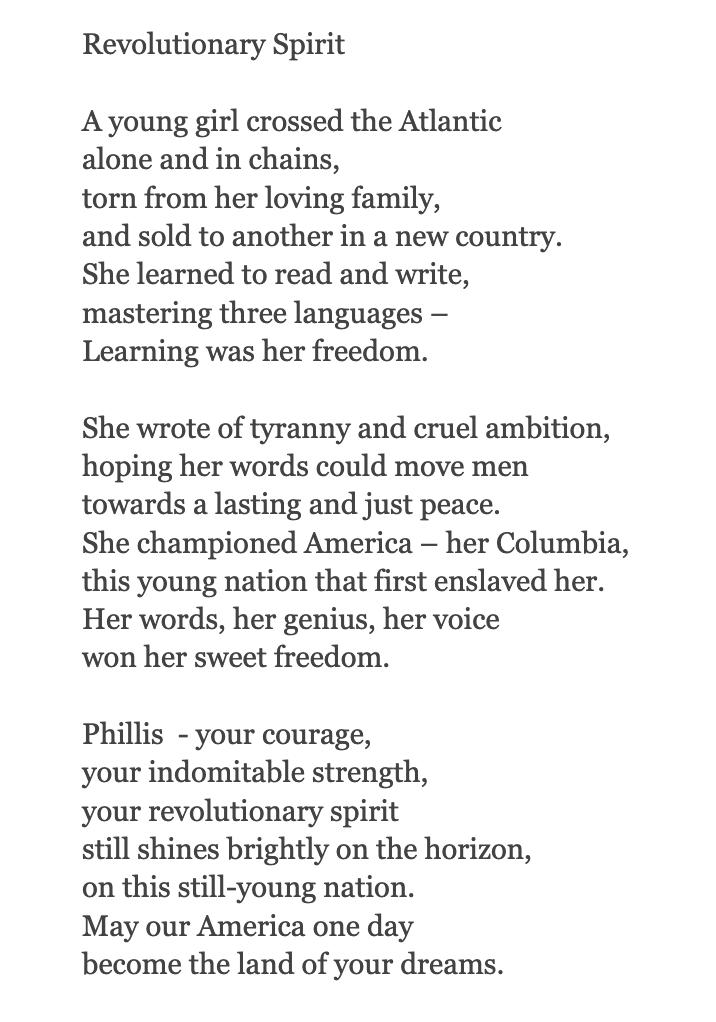


A great slice with the 4th of July coming up. We need to remember heroes who have fought to make our nation the land of the free and continue the fight today.
LikeLiked by 1 person
Your post is a wonderful reminder of the power of so many women, slaves, and other marginalized individuals in the forming of our country. A good reminder this holiday weekend.
LikeLiked by 1 person
Thank you for this patriotic and heart-breaking poem. I did not realize that she died so young.
Indeed.
LikeLiked by 1 person
The education of enslaved / oppressed people brings into focus the privilege teachers possess and offer. In today’s terms, we face new challenges of convincing others of the privilege it offers as well as our need for it when education seems too accessible to many. The value of it and the definition of it being tarnished and twisted by the ease of commerce and the entertainment value of misinformation. Phyllis continues to speak. If ony we listen. Thank you for lifting up her voice!
LikeLiked by 1 person
Great poem to honor Phillis Wheatley’s courage and strength. My favorite line is “Learning was her freedom,” as it should be for everyone.
LikeLiked by 1 person
Noange,
I was thinking about Phyllis Wheatley earlier this week. She was poor and could not afford the publication cost of publishing a second volume of her poetry. She’s certainly a hero among poets. Thank you for honoring her.
LikeLiked by 1 person
I appreciate reading about the women of the American Revolution! There are so many of them that made our world so much better!
LikeLiked by 1 person