This week, I shared one of my all-time favorite childhood summer pastimes, running under the sprinkler. I have a fear that this is becoming a relic – an ancient ritual that is now supplanted by indoor air-conditioned video-gaming. I wanted to show my students a simpler time when backyard fun reigned supreme. I can still hear the rhythmic clack-clack-clack of an oscillating sprinkler, a sudden burst of icy water, and the delighted screeching of children leaping through the mist. Summer moments like these are filled with sensory details, making them the perfect catalyst for stretching our vocabulary muscles and creating poetry.
Because students often struggle to create vivid imagery out of thin air, they frequently fall back on clichés or stare blankly at a white page. However, using a concrete visual prompt, such as a photograph of a girl splashing under a backyard sprinkler, can instantly unlock their imagination. This image helps student to tap into their own memories, stretch their vocabulary, and express themselves through poetry.
When I showed the photograph below to my student, I asked them to “be the girl in the photograph.” They needed to look closely and imagine themselves in that exact spot. Then we generated a list of vocabulary words based on our senses.
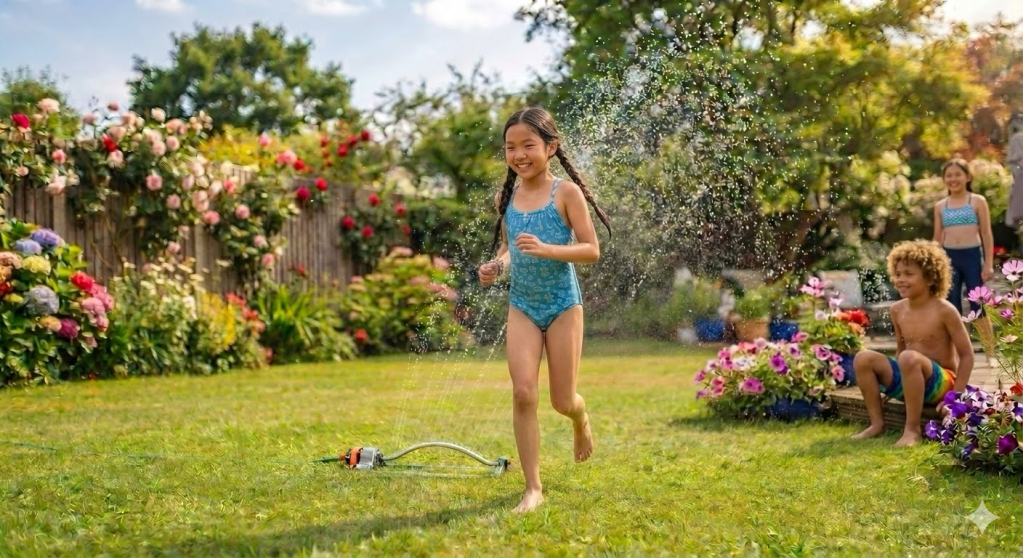
- See it: What do you see? (i.e.: girl in blue bathing suit, kids laughing, sprinkler shooting out water, green grass, and pink flowers).
- Hear it: What sound does the sprinkler make? (i.e.: shh-shh-shh, click-click, hiss, splash).
- Feel it: How does the water feel on a scorching day? (i.e.: icy, stinging, freezing goosebumps, tickling).
- Smell it: What does a wet backyard smell like? (i.e.: wet dirt, cut grass, sweet flowers).
I wanted the girls to focus on descriptive language and not use the same old tired and boring words like nice, fun, good, hot, etc. We created a list of synonyms we might try instead of the words we use all the time every day. We wanted our writing to be new and exciting.
| Instead of… | Try using… |
| Cold | Freezing, icy, shivering, refreshing |
| Water | Droplets, spray, mist, showers |
| Running | Leaping, charging, zooming, prancing |
| Hot | Sizzling, baking, melting, roasting |
I gave the girls one final coaching tip before sending them off to write. I reassured them that they do not have to rhyme. That the poem should be long enough to describe the action in the photograph and bring the audience into that moment. I suggested that they could…
- Tell us about the weather.
- Introduce a sound or two.
- Describe and imagine the action.
- Describe a physical or emotional feeling.
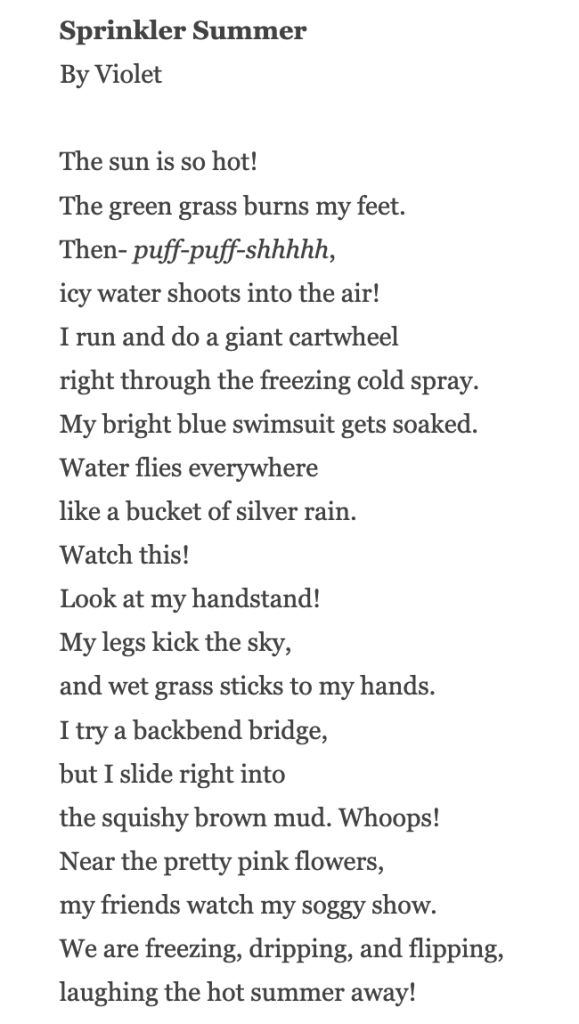
Teacher Reflection
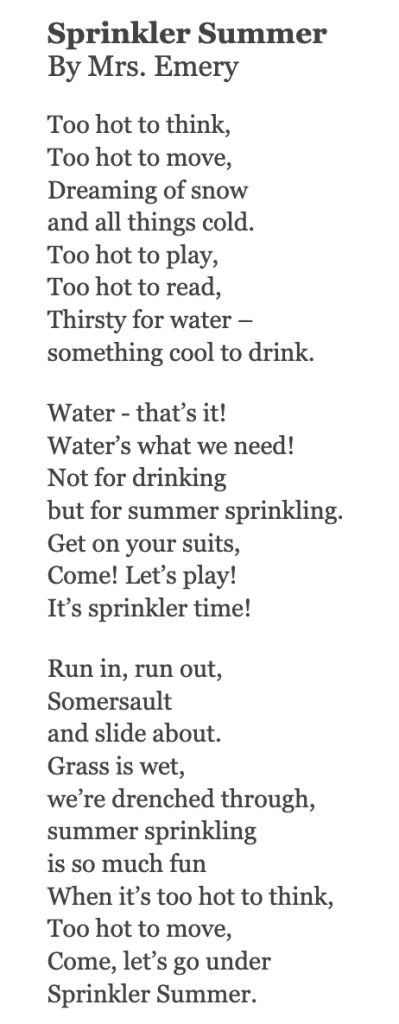
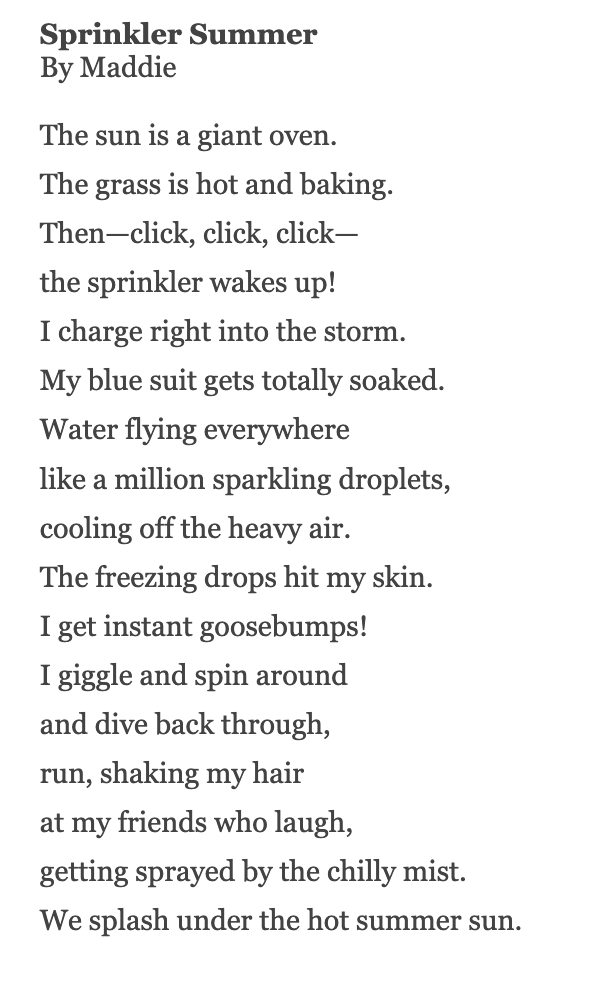
I think my decision to scaffold vivid words helped Maddie and Violet have a firm foundation on which to write their poem. They referred to the photograph often as they composed, and they frequently stopped to share their personal stories of playing with friends and cousins under the sprinkler or on the Slip-and-Slide. Having that background knowledge was also key in creating a realistic small summer moment. Pausing to write poetry was also an intentional plan on my part because I wanted to keep up my students’ stamina and interest. This assignment was a low-stakes and fun way to keep writing.


Joanne, I love the poems! Your mini lesson on the front end certainly added depth and joy. The girls seem to have experience with sprinklers. Or at least they are motivated to get out there this summer. I’m just leaving Seattle, and one day my grandson played in the water, while the neighbor girls ran through their sprinkler. He sprayed them over the fence sometimes with lots of giggles all around.
LikeLiked by 1 person
Great! All three poems came alive, from the exploration of senses and uncommon words to use. I especially like Violet’s puff-puff-shhhhh of the sprinkler getting started- so vivid! Wonderful mini-lesson, and I think you are right- it helps that your image was one they could relate to easily.
LikeLiked by 1 person
Thank you for letting me be a fly on the wall during this lesson. I love how you used the image and pushed to have a stronger vocabulary list. Maddie and Violet soared with your modeling!
LikeLiked by 1 person
What a visceral memory for someone in my 50s. I noticed that local parks near where I live in Michigan are offering “splash pads” which aren’t grassy (but cement) and the water streams are thicker. The splat splat splat of the water gushing onto concrete is hypnotic as well. The community of a public space vs. the private yard of a sprinkler run is also a factor. The lazy afternoon feeling of relief and quintessential summer of it all, is epic.
LikeLiked by 1 person
These poems were like a Time Machine for me – taking me back to the hot summer days of my childhood! I really enjoyed reading your example and the responses of your young poets. You all captured the sprinkler experience with sensory details. The scent of a sprinkler splashing on the hot ground is one of my favorite aromas.
LikeLike
So much to love here:
““be the girl in the photograph.”
synonym suggestions
examples of fabulous poems
plus it awakened my own memories of summer sprinkler days. Thank you!
LikeLiked by 1 person
This is inspiring at so many levels. Even for adults, your prompts are effective. Your students open up like flowers watered on a sunny day.
LikeLiked by 2 people
Love these—and the power of an image to spark creativity. Those flowers were watching in awe as the girls found just the right words!
LikeLiked by 1 person