This week, Henry celebrated his 46th birthday. I called him to wish him a happy and healthy day. Forty-two years ago, I planned his 4th birthday party and made it as happy as I could possibly make it. He was my student, and I became in charge of his care three months prior when his mother died after being hit by a drunk driver. That little boy crawled inside my heart and never let go, and I never let go of him, though we did lose touch with each other for four decades. Six years ago, he came back into my life, and I am so grateful, so happy that he now has two little girls and an adoring wife. I am so happy that he is happy. It makes everything all right in the world.
When I called him this week, he thanked me for remembering his birthday. I told him that all those years when we weren’t in touch, and I didn’t know where he was or what he was doing, every June 4th, “ I would whisper into the air and up into the clouds, “Happy Birthday, Henry, wherever you are! Stay safe. Be happy.” I sometimes feel foolish revealing to Henry how I feel about him, but he always quietly reassures me that he deeply appreciates my care and concern. When he asks me what I’ve been up to, I rattle something about putting my attention to poetry this summer. And Henry says, “I don’t know who said it, but someone said, poetry is like someone running at you with a knife in a dark hallway.” That stopped me in my tracks. He was right. Good poetry stuns, surprises with sharp clarity. It is an idea I will take with me this summer, as I turn my attention from teaching to writing.
I remember a quote by the children’s author, Kate Di Camillo: “So much of writing is like walking down a dark hallway with your arms out in front of you. You bump into a lot of things.” It is the idea that Henry was suggesting. Poetry is sharp and visceral. It captures that exact small moment and lunges past all our defenses, taking our breath away for a moment, and confronting us with something terrifyingly true – so true and raw that we can’t stop looking at it. I think the poems I wrote when I was younger had this intensity. As I age, I find I’m looking for peace, for a respite from the world. Though my youthful poetry had the intensity, it didn’t always have the clarity. I’m searching for both the surprise and clarity of vision that comes with age.
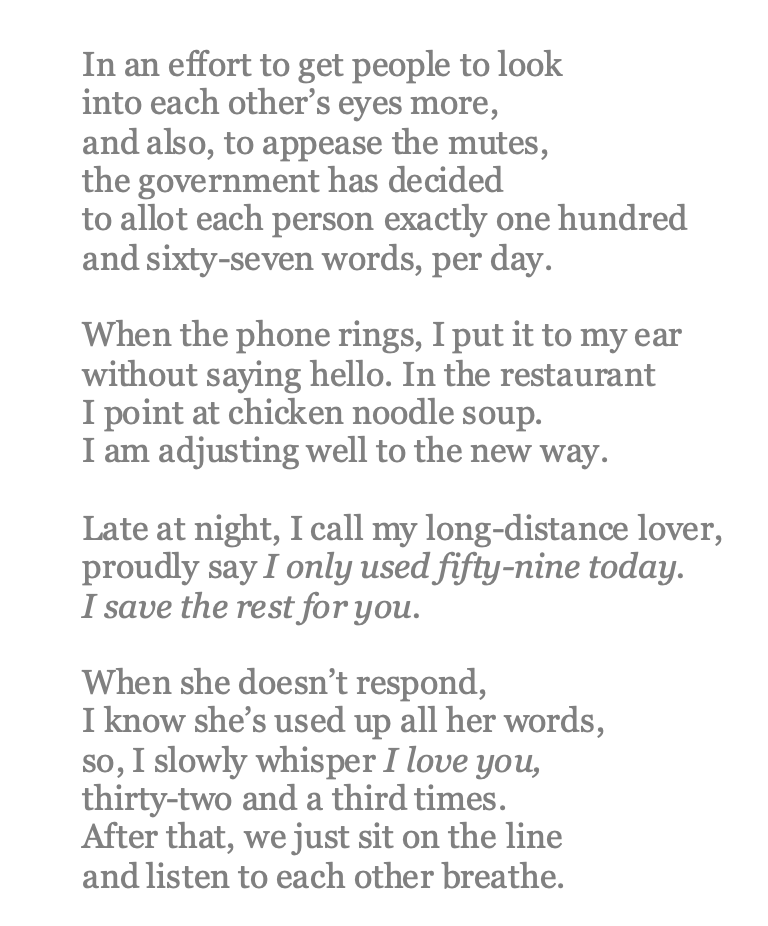
Daniel Seifert, in a recent blog post, notes that using restriction as a poetic impetus has been helpful to him: For me, poetry is communication condensed, stripped of what is superfluous until the words that remain shine like opals, washed clean of mud. I often find that restricting language or using a new poetic form sharpens my language, makes poetry writing new for me, and gives my writing the authentic charge I am trying to attain. Jeffrey McDaniel’s Poem, The Quiet World,” shows this idea perfectly:
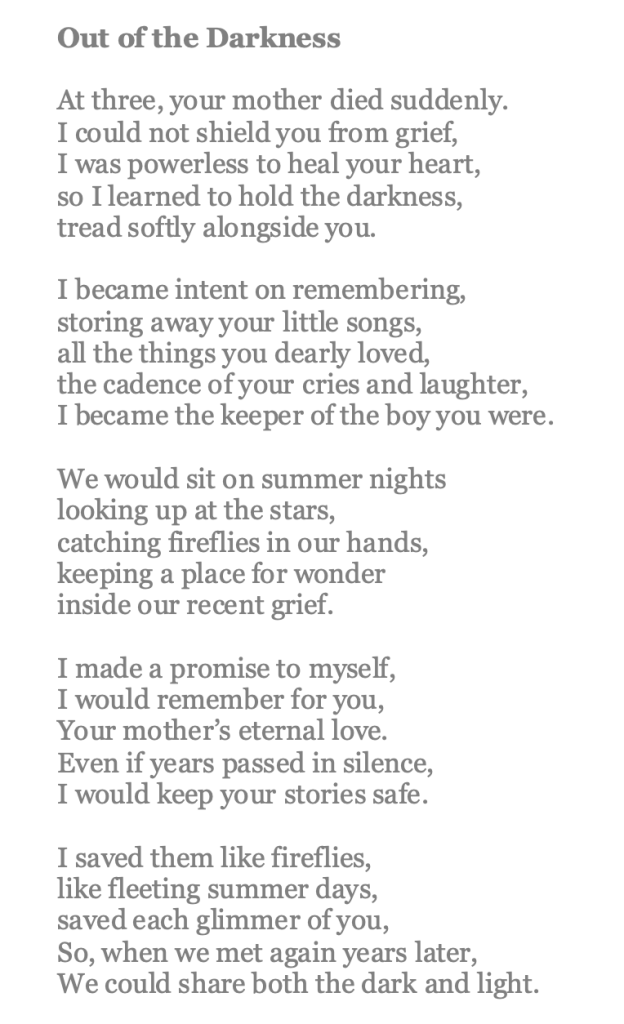
So, I’ve sat this weekend, thinking about the time long-ago when Henry was turning three, and I was just twenty-seven. We were traveling in a new territory – grief. I longed to protect him, but he was already wounded, and I could not save him from grief. I could just promise myself that I would remain connected to him, even if we drifted apart, even if we didn’t speak for years. I would store up all the memories of that time, so I could tell him at a later time, when he was all grown up. I believed that we would meet again, and I would know that he was happy and safe, because that is all I ever wished for him. I tried to strip all those memories and feelings bare to create a poem that runs from the darkness until it finds a point of light.
 Word Dancer: Literature, the Arts, & Education
This is incredibly moving. Your words beautifully express the fierce and gentle love that comes from watching a child.
LikeLiked by 1 person
So beautiful! From so many memories and emotions, you have chosen just the right words.
LikeLiked by 1 person
What a lovely tribute as you continue to hold the past and present so as to honor and not to fix. Incredibly moving! Thanks for sharing!
LikeLiked by 1 person
Your words paint a picture of a love that transcends time and space. What you did for that little boy clearly made an impression and a difference in his life. I am glad you are back in touch.
LikeLiked by 1 person
Oh wow, this is beautiful. I appreciated the early reassurance that Henry is okay and happy in his adult life. What a poem you’ve written. Talk about a sharp knife in a dark hallway.
LikeLiked by 1 person
I love this way of looking at poetry – looking at it in ways I haven’t considered. I also love the reconnection to that scared, hurting little boy. What a time that must have been for you both. I appreciate your sharing of both the now & the then.
LikeLiked by 1 person
Beautiful.
You brought Henry to life and shared why he would matter to us as readers!
LikeLiked by 1 person
Word Dancer,
This is so incredibly beautiful. I’m so happy that you and Henry are back in touch and able to share how much you mean to each other.
What a gift for both of you.
How beautiful that you focused on witnessing and remembering both his grief and his mother’s love instead of trying to fix things. I can think of no better way to help someone who’s grieving.
Thank you for sharing such a tender and important part of your life.
LikeLiked by 1 person
Thanks for sharing such a vulnerable part of yourself. How hard it must’ve been for you to take on this young boy’s grief at such a young age. I am touched that you have reconnected and hope that your relationship continues to grow in love and truth.
LikeLiked by 1 person
Hi Margaret – It was the hardest and best thing I ever did in my life. Henry is part of my heart, and I wouldn’t do anything to change that. I know you understand very well.
LikeLiked by 1 person