
Some words feel wonderful in your mouth: benevolent, pashmina, Constantinople. They roll right off one’s tongue and into one’s imagination. Words hold meaning and are the building blocks of all human thought. I marvel at students’ curiosity about words and how they often understand and use words far above their age and grade level. One of my students was so enamored with geology and dinosaurs that his vocabulary in these areas far surpassed mine, allowing him to be my teacher, and I, his attentive student! I believe that spark of curiosity and imagination in learning vocabulary ignites the power to explore a universe of ideas and concepts. I’ve taken this first week of my summer vacation to reflect on the techniques I’ve used to support students’ vocabulary development.
Word Journals
Many students have reading, writing, and math journals to help them process and organize all the new ideas they are learning. Word journals are an interactive way to learn and remember new vocabulary. It is much more dynamic than vocabulary workbooks, which tend to make students passive rather than engaged learners. The word journals I’ve created with students consist of the students building their own four-square Frayer Model for each vocabulary word we are studying. This graphic organizer asks the student to write the word, its definition, find an antonym and a synonym, draw a picture, and write a sentence. This visual representation helps students to remember the word, and by adding synonyms and antonyms, students build their vocabulary knowledge with each new word they encounter.
A modification of the Frayer Model can be used with K-2 students. Young children are often inquisitive about the new words they encounter. To build on this natural curiosity, students can be encouraged to keep a word journal that includes the focus word, its definition, a picture of the word, and, as young writers develop, a sentence. Often these sentences grow into imaginative stories.
Frayer Model Graphic Organizer Samples for K-2 and 3-5
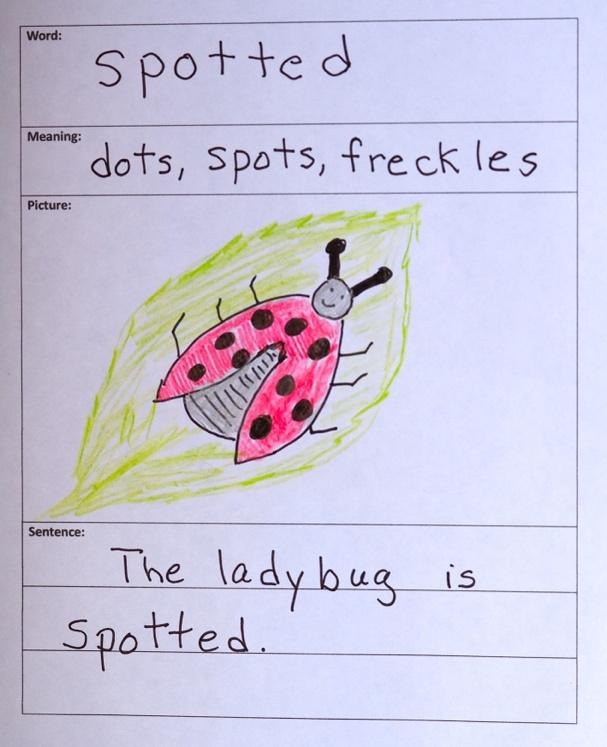
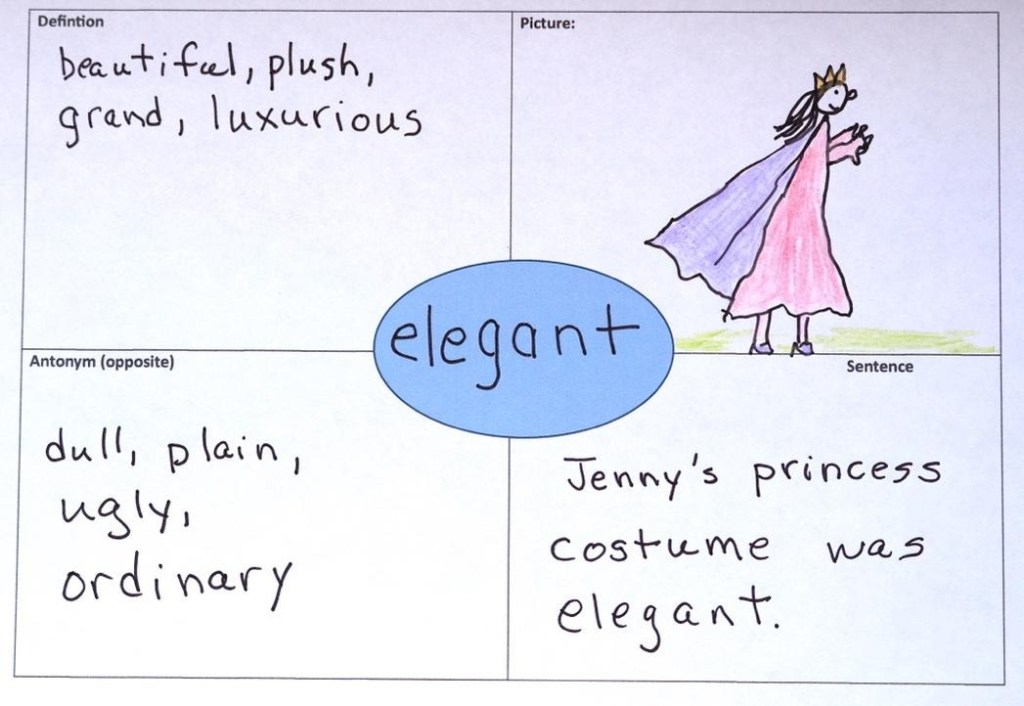
A New Look at Word Walls.
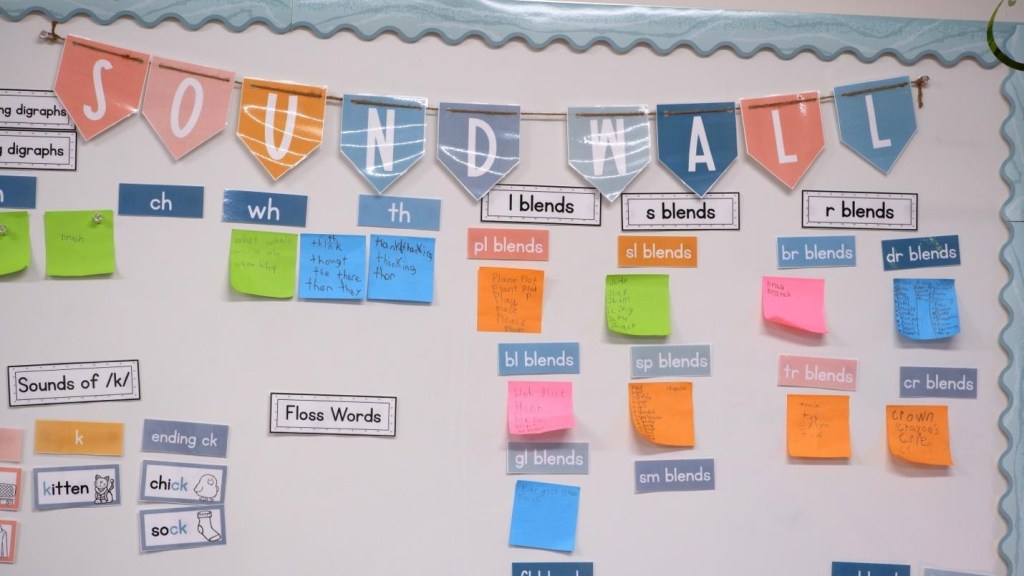
Word walls are traditional ways in which to document vocabulary study. There are many types and styles of word walls. Recently, sound walls have been introduced, and there is debate about which are more effective. I think incorporating both types of walls is beneficial. Sound walls help students learn words by their phonemic features, and word walls allow students to develop a strong vocabulary across the curriculum. Word walls are most effective when they are socially constructed with students actively engaged in their construction and reconstruction across the school year. In this way, vocabulary becomes paramount, and words come alive and are a living part of the class community.
Wonder Words
Another idea I’ve used in my classroom and also with the whole school community is the Wonder Word program. Each week of the school year, we feature a new word for the students to learn and think about. Many of the Wonder Words coincide with a current theme such as “community” in September to begin the year, “gratitude” in November to acknowledge Thanksgiving, or “absurd” in March to celebrate the work of Dr. Seuss. These connections allow students to associate and visualize, helping them put new words into their long-term memory. At the end of the year, older students work together to create a vocabulary quiz show that incorporates some of their favorite words, and the whole school participates during our final school assembly. In this way, all students celebrate the wonder of the words they’ve learned throughout the year. At the core of vocabulary learning is the love of words, the pure joy of expressing yourself with wondrous words that roll off your tongue!
Charlotte’s Corner
To highlight vocabulary from the literature we read throughout the year, I have created a word web in the corner of my reading area where the students and I post words from the books we are reading. This idea came from one of my favorite books, Charlotte’s Web by E.B. White. Charlotte was the consummate logophile (word lover). She solved many a problem using her vocabulary skills. I want to instill that kind of love and power of words in my students. They are excited to add words to the web and enjoy sharing their words with classmates.
Celebrate with a Vocabulary Parade
This idea came from the book, Miss Alaineus by Debra Fraiser. Sage, the young protagonist, tells the story of her class’s 10th Annual Vocabulary Parade. Throughout her telling, Sage describes and defines the words she encounters. However, one word has her confused, and she declares that Miss Alaineus (miscellaneous) is the woman on the green box of pasta with wild spaghetti hair because her mother said she was getting miscellaneous things in the grocery store and came back with that green pasta box. This misunderstanding leads to both conflict and humor as student prepare for the 10th Annual Vocabulary Parade. I have facilitated vocabulary parades at the end of the school year with my classes to celebrate all the wonderful words we have learned. Students choose a word and dress up as that word. They have chosen some very interesting words to portray, from their favorite vegetable, color, or sport to more technical words like photosynthesis, quotient, and archaeology. Students have also chosen words in their native language. This is definitely an activity that makes word learning memorable.
Vocabulary Resources:
Vocabulary Building Books for Teachers
- Bringing Words to Life by Isabel Beck
- Choice Words by Peter Johnson
- Opening Minds by Peter Johnson
- Wondrous Words by Katie Wood Ray
- Word Nerds by Brenda J. Overturf
Picture Books that Encourage Vocabulary Development
- All the Water in the World by Ella George Lyon
- Alphabetter
- Amelia Bedelia (series) by Peggy Parish
- Chyrsanthemum by Kevin Henkes
- Fancy Nancy (series) by Jane O’Connor
- Lexie the Word Wrangler by Rebecca Van Slyke
- Max’s Words by Kate Banks
- Miss Alaineus by Debra Fraiser
- One Word From Sophia by Jim Averbeck
- Pete’s a Pizza by William Steig
- Take Away the A by Michael Escoffier
- Theasuarus Rex by Laya Steinberg
- The Boy Who Loved Words by Roni Schotter
- The Day Saida Arrived by Susana Gomez Redondo
- The Great Dictionary Caper by Judy Sierra
- The Keeper of Wild Words by Brooke Smith
- The King Who Rained by Fed Gwynne
- The Word Collector by Peter H. Reynolds
- Wild Berries by Julie Flett book
Nonfiction Vocabulary Books for Kids
- 101 Collective Nouns by Jennifer Cossins
- Stroll and Walk, Babble and Talk: More about Synonyms by Brian P. Cleary
- The Lost Words by Jackie Morris and Robert Macfarlane
- Water Land: Land and Water Forms Around the World by Christy Hale
- What a Wonderful Word by Nicola Edwards
- Yakety Yak: Animal Names that are also Action Words by Kathy Broderick
Vocabulary Board Games
- Banagrams – anagram tile game – ages 7 and up
- Blurt! – ages 7 and up
- Boggle – short word game – ages 8 and up
- Buzz Word – ages 10 and up
- Lexigo – ages 10 and up
- Password – ages 8 and up
- Quiddler – short word card game – ages 8 and up
- Scrabble Slam – card game – ages 8 and up
- Spell it! – alphabet dice game – ages 8 and up
- Spelloker – word building – scores like poker – ages 8 and up
- The Origin or Expressions – idiom game – ages 12 and up
- Word on the Street – (category word game) – ages 12 and up
- Word Thief – ages 9 and up
- You’ve Been Sentenced – sentence building game – ages 8 and up


Joanne,
These are wonderful ideas. I love the idea of dressing up as a word. I had a class years ago in which I learned to write a definition essay. Early in my career I taught that form. I stopped as ELA moved away from modal writing, something I’m not sure was a good idea. I taught a lot of new vocabulary in the dual credit speech classes, so at the end of the course each student chose a word to represent at a mocktail party. They created business cards to pass out and used them to introduce themselves. It was the highlight of the course and so much fun.
LikeLiked by 1 person
A mocktail party with business cards – that sounds like so much fun! Thanks for sharing, Glenda.
LikeLiked by 1 person
What a wealth of resources here! I love that the last book listed is, You’ve Been Sentenced. What a terrific title—and all too often, the way vocabulary study is conducted, as a punishment rather than an endless discovery that give way to the power of better communication (and can’t we all use that?!).
LikeLiked by 1 person
Oh, how you make me want to take a stack of books and go sit in a corner with a pile of sentence strips to write words and post them in my corner unto myself as I read…..you have a great collection of ideas for teaching vocabulary here. Thank you for sharing. I recall a thin paperback similar to some of your books, entitled The Word Collector by Peter Reynolds and it makes me smile every time I read it. You always keep such great ideas coming our way.
LikeLiked by 1 person
You have put a lot of thought into this! It makes me miss having my own classroom. I am going to get some of the picture books for my grandkids, though, and read them with them. Thanks for the ideas!
LikeLiked by 1 person
What a great slice! FIlled with Word ideas! Thaks for sharing. I am heading to K next year and plan to reread your slice come August! Definitely one to bookmark. Thanks for the images and lists!
LikeLiked by 1 person
Charlotte’s Corner – what an awesome way to be a word collector. I’m thinking about the non-English words that amazing authors like Patricia Polacco (Yiddish), Matt de la Peña and Yuyi Morales (Spanish) bring to our world, too.
LikeLiked by 1 person
Absolutely love the addition of other languages and have used the work of those authors. Thanks for the reminder!
LikeLike
Love all your creative word ideas!
LikeLiked by 1 person
I just love that you are using Miss Alaineus and Charlotte’s Web as means fo focusing your word study and thinking! These are such real and organic ideas that support real learning, Not too long ago I share a Frayer Model with a group of grad students and one student remarked, “I could never use that! It is an old idea from when I was a student and cannot possibly be used any more!” Sigh, I helped her rethijk her stance!
LikeLiked by 1 person
I know – many young teachers think old is obsolete, but I am making it my final mission to show them that old ideas are often very valuable and effective.
LikeLike