
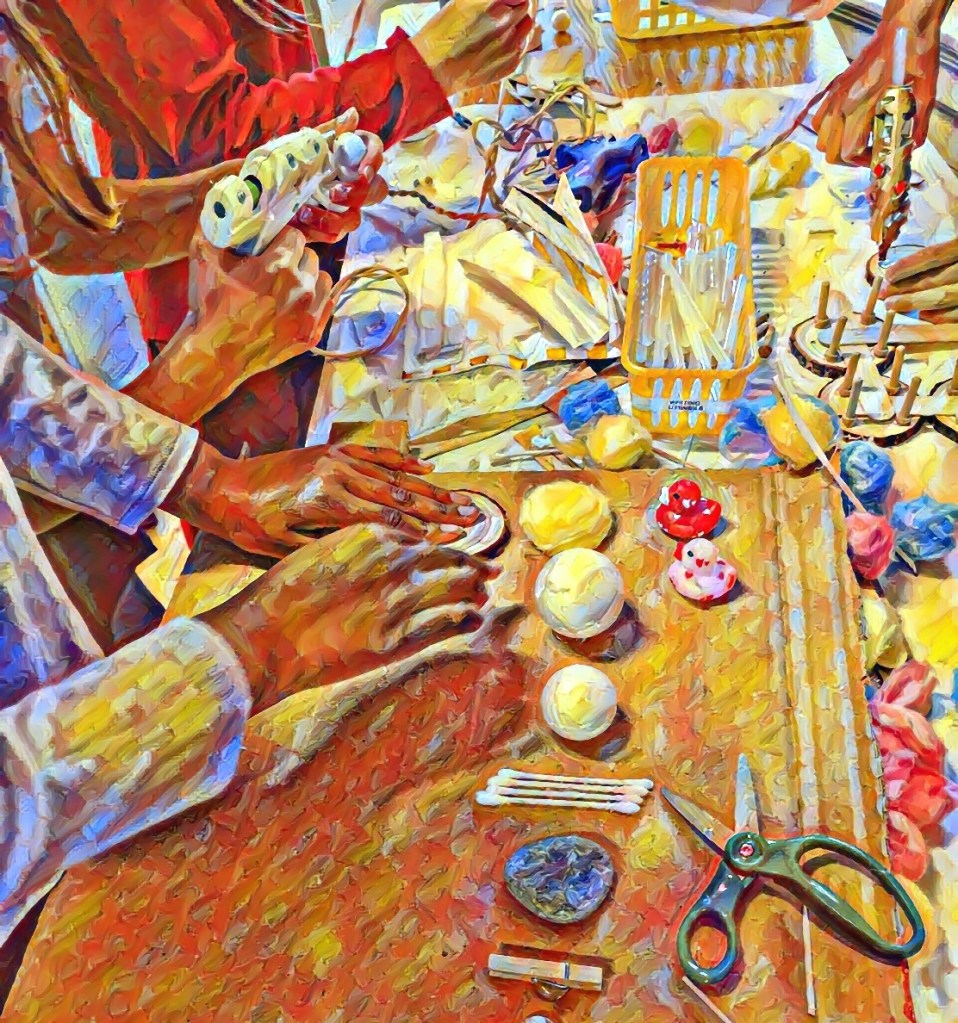
The Wonder Studio is my school’s dedicated space for hands-on exploration, innovation, and growth, which I created over 10 years ago. I recently heard a high school student explain the studio to parents, adding that we did not have this space when she was younger. She wished we had, and I do too! If you visit the Wonder Studio, you would see our young craft-makers in action—not just creating beautiful projects but actively building their minds. True learning requires creativity and an active imagination, but it also takes the courage to step outside your comfort zone. Here, students have the autonomy to lead their own designs and the freedom to engage in every part of the design process. They are also given the space and support to navigate unexpected challenges. I celebrate mistakes as data, teaching my students how to fail forward with resilience. Every cut, glue stroke, stitch, and prototype is proof that when children design their own worlds, they unlock their full potential as thinkers, problem-solvers, and lifelong learners.
In October, the 4th graders came to the Wonder Studio and got busy building with cardboard. They loved making fidget boards and designing miniature rooms for little potato people that they made with a 3D printer at home. I try to reserve the studio space for hand-crafting without technology, but I loved how the girls used the technology they are learning in CS&E (Computer Science and Engineering) and at home to create projects they build from cardboard scraps and popsicles. There is something so satisfying about that.
Over the years, I’ve found that the Wonder Studio’s ethos of crafting for learning encompasses six main areas of development: fine motor skills and dexterity, spatial awareness and geometry, resilience and problem-solving, collaboration and communication, creative focus and agency, and mindfulness and relaxation. To the outside observer, Wonder Studio may look like a place that is a chaotic, unstructured mess. However, on deeper reflection, one can witness all seven of those main areas of development being actively and joyfully engaged every day.
Fine Motor Skills & Dexterity
During Wonder Studio, there is time for students to paint, cut, hammer, glue, assemble, and sew. It is where everything we do is all hands-on-deck. There is a sense of easy camaraderie where one child holds a piece of wood while another saws it, or where another child stacks boxes one on top of the other and asks her friend to hold the pieces together as she secures them with glue. I love watching the girls work with their hands, finding strength in learning new skills. This month, I taught A. how to use a hammer and nails so she could make a miniature bookcase. As we worked, I found such a peaceful rhythm guiding and encouraging her. When we were done, she felt confident and was able to teach another student how to get the nail in the right position to hammer. Her friend, K., loves working in great detail. She created a miniature classroom complete with student desks, chairs, and coat hooks. K, had an assembly line of production going and worked with great precision.
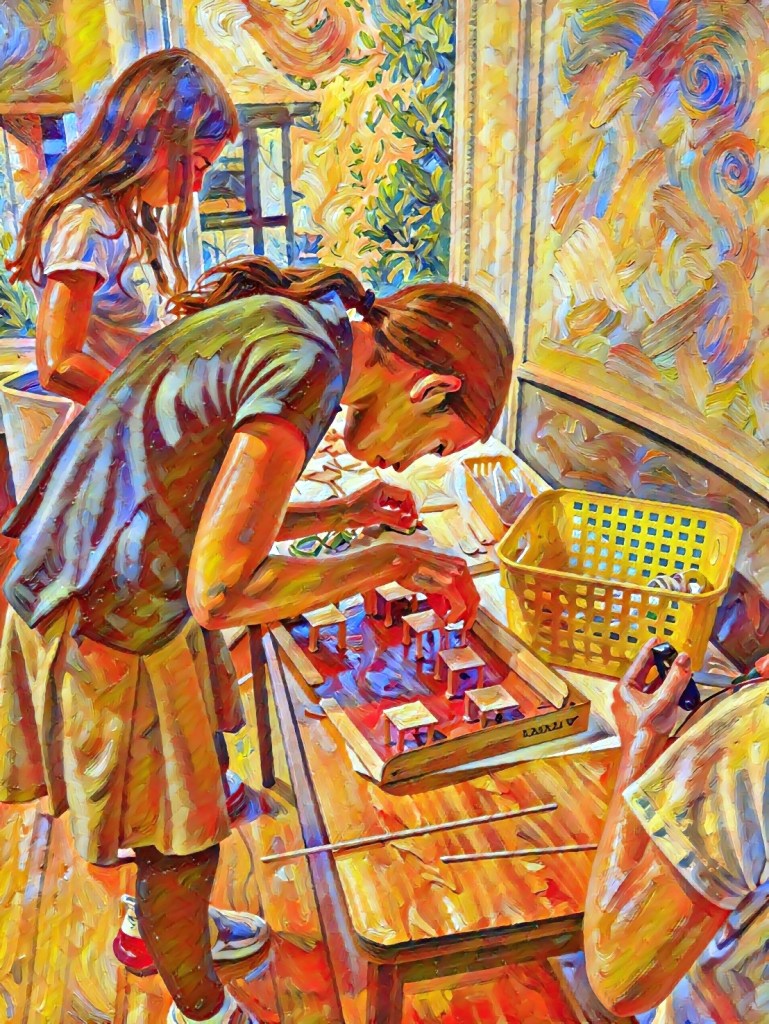
Cutting, gluing, painting, woodworking, threading,
and sculpting strengthen small hand muscles required for writing.
Spatial Awareness & Geometry:
Teachers often talk about lessons to build spatial awareness and geometry skills. They have a list of criteria and some paper and pencil activities. However, I’ve found that these skills are best done in real-life practice. The 4th graders love looking through all my bins of materials to come up with something new. B. took a liking to my tree slice rounds and began assembling them with hot glue. When asked what she was making, she turned her work right-side up to reveal an elaborate table connected by tongue depressors. There was something geometrically beautiful about her creation. It could have been modern sculpture.
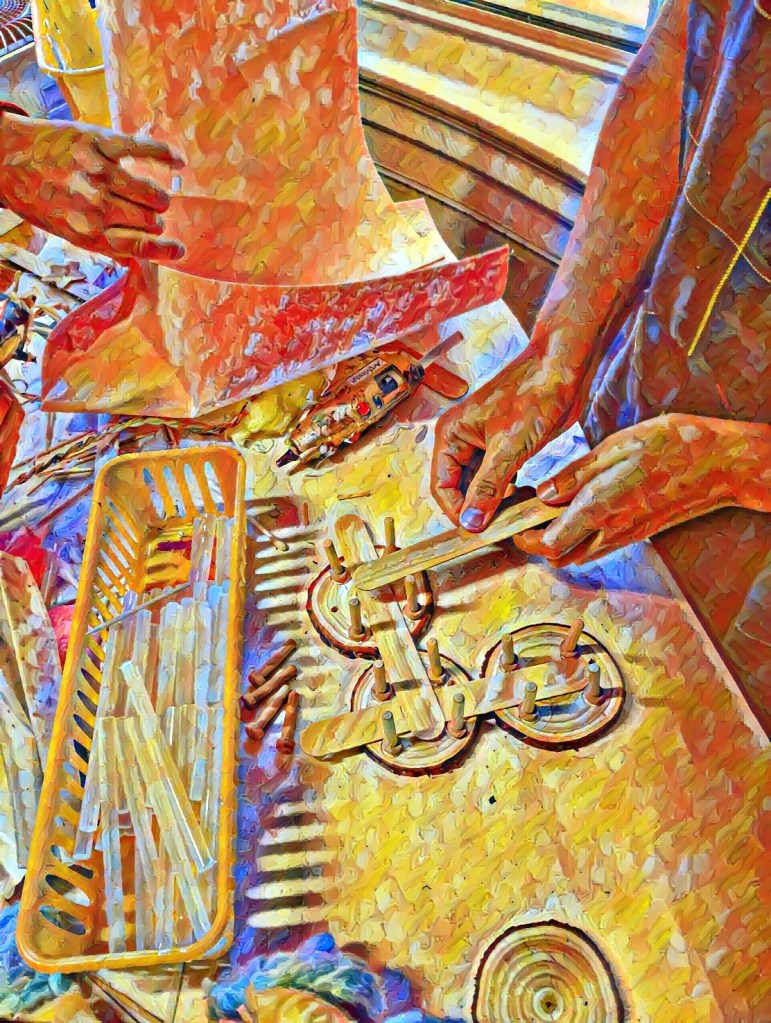
Manipulating 3D shapes, building with cardboard,
and working with fabric help kids understand scale and geometry.
Resilience & Problem Solving:
L. loves to create. This is her second year in the studio, and she chooses to come every day. She crafts at home, and her parents have set up a space dedicated to tinkering. With that foundation, she is an intrepid maker. L. quickly comes up with ideas and puts them into action. If at first they don’t work out as she had intended, L. will pivot and make the necessary changes. There are no tears, just opportunity. L. is the model of creative spirit. While her peers were building cardboard houses, hospitals, and classrooms. She chose to create an ambulance and a gurney that could be wheeled into the ambulance. I marvel at her ingenuity, supply her with the materials she requests, help her problem-solve when she’s stuck, and then I step out of the way.
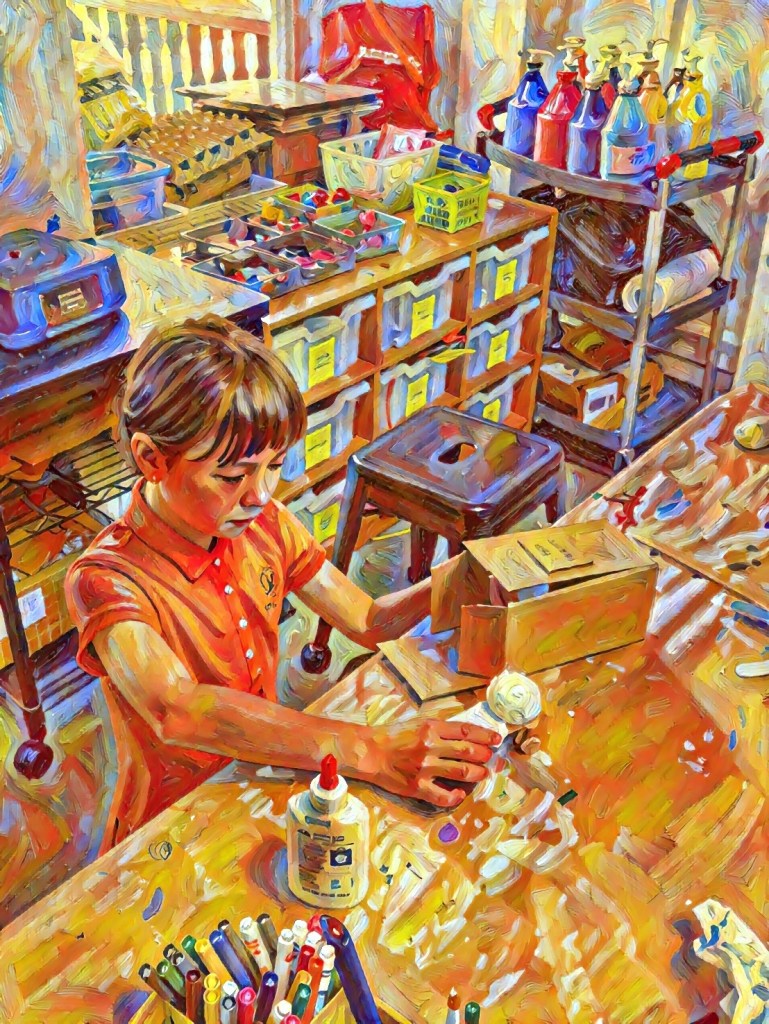
When a structure collapses, or glue won’t hold, students analyze the failure,
adapt their plan and try again.
Collaboration & Communication:
The thing that immediately struck me when the 4th graders entered Wonder Studio this month is that they came in with a purpose and a plan. In the first fifteen minutes, they were busy at the hot glue station creating fidget boards and working cooperatively. There was no complaining. Everyone waited their turn and shared graciously. They were experts at working together. They didn’t need any adult oversight or reminders. They focused on their work and helped their peers. The studio space encourages this creative exchange of ideas. The girls know each other’s projects and will offer suggestions as they work together. This will be our last week together until February, so I asked them if they’d like to plan a class project that would include building. They replied with a resounding, “YES,” so I promised that I would talk to their teachers and find a way to incorporate building into their social studies classes.
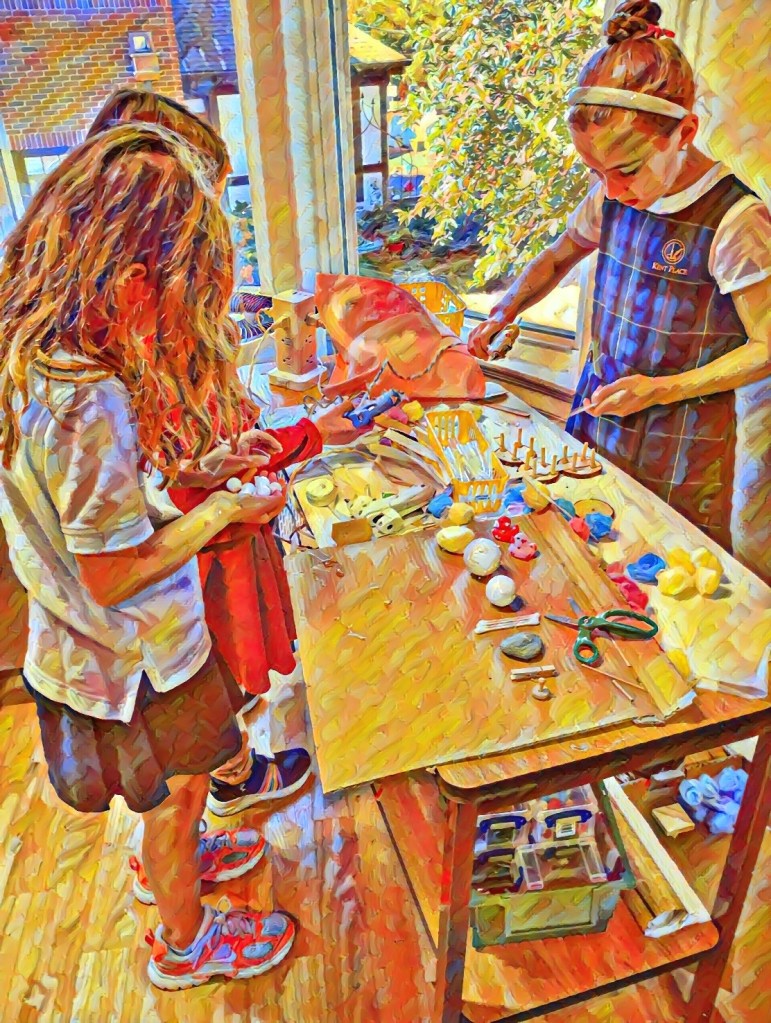
Sharing tools and trading design ideas teaches students how to negotiate, explain
concepts, and work as a team.
Creative Focus & Agency:
While everyone was busy working at a communal craft table. C. was quietly off to the side making something that would go with one of her friend’s houses. She worked intently during one session and then came over to me to show the handiwork she was so proud of: a wooden bed with a tissue paper quilt and a yellow pom-pom pillow. C.’s fingers were fast and nimble. She was clearly proud of her craftsmanship.
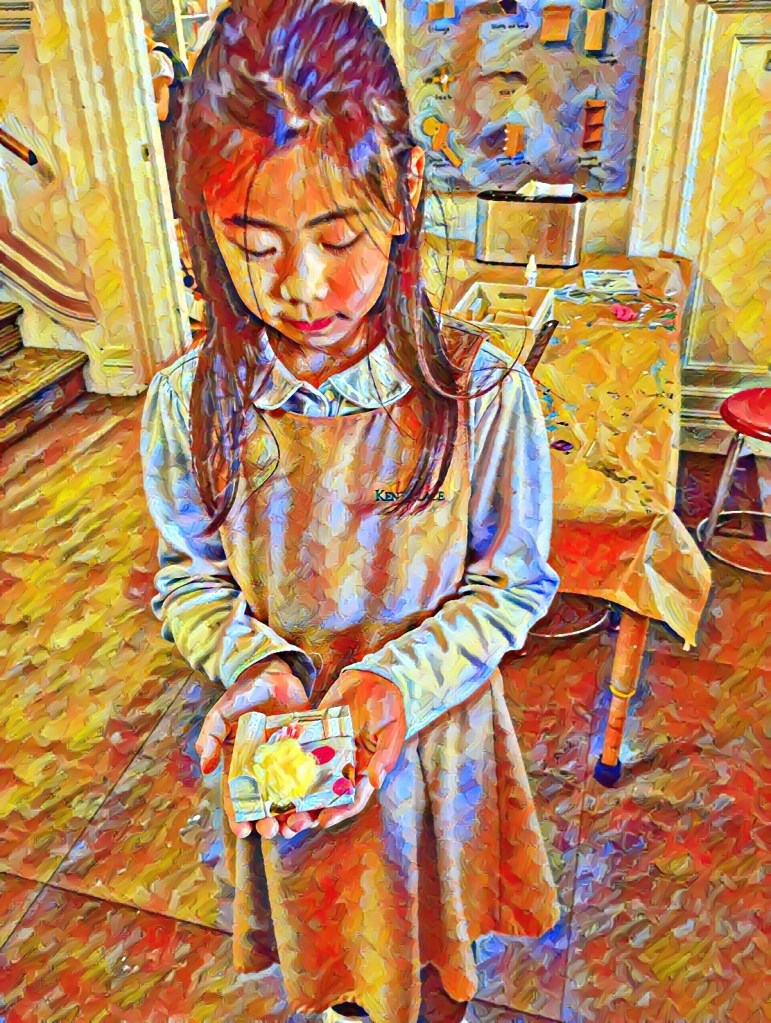
Transforming raw materials into an original
project builds intrinsic motivation, focus, and self-expression.
Mindfulness and Relaxation:
I observe students in class and in the studio, and I notice the studio gives them more freedom to learn intentionally. They are not told what to do. They craft their own learning. And because of that, they can relax and not be stressed by someone else’s expectations. I love watching the girls work so quietly and carefully, completing work efficiently, whereas in the classroom they might have to be cajoled to finish.
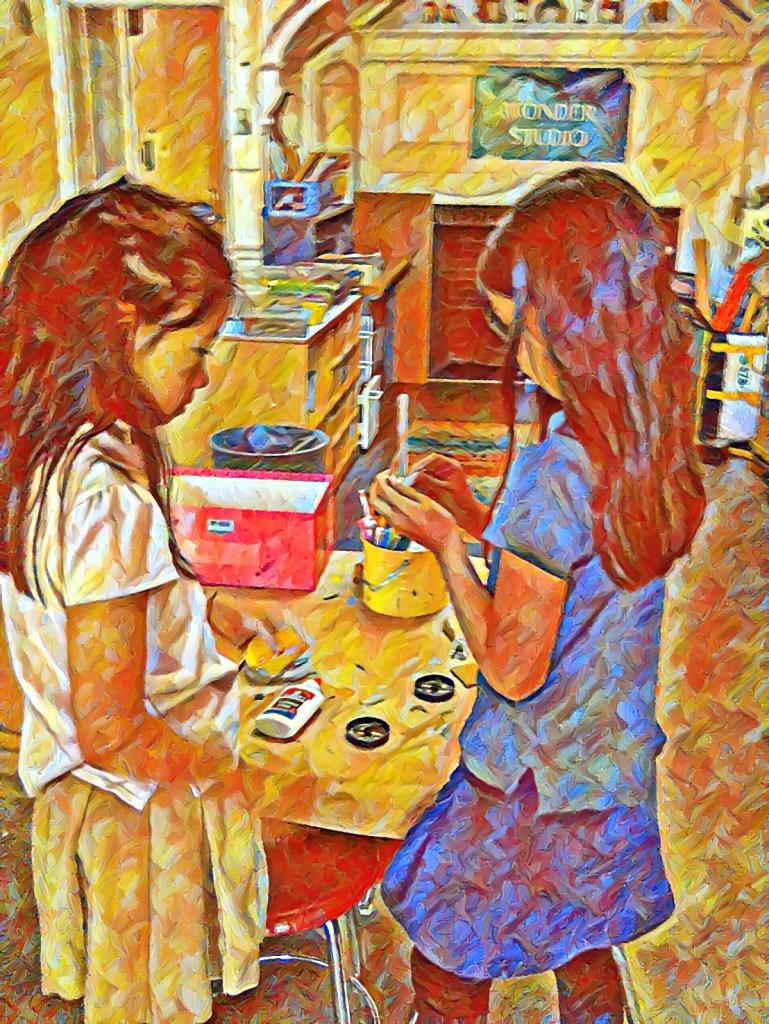
Deep immersion in a creative task (flow) fosters
sustained attention, mindfulness, and healthy
temporary escape from daily stressors.
Wonder Studio and Beyond
This is 4th grade’s final week of studio time. They will get another chance after the 3rd and 5th grades get their 6-week rotations. I will see them in 12 weeks, which seems so far away. Since they have worked so well, I hope to give them more time during their class time, so that they can continue imagining and building. I plan to share a survey with all of them so that the next time we meet, I can have a clear idea of what they are thinking and how to better prepare the studio space for them. Here are some of my survey questions:
- What is one mistake you made, and how did you fix it?
- How did you use your imagination to change your original plan?
- What tool or material was the hardest to use? How did you get better at it?
- How did a classmate help you solve a design problem?
- If you had one more hour to work on this, what would you add or change?
- What is something you tried that you have never tried before?
The Wonder Studio is so much more than a room filled with cardboard, hot glue, and scrap materials; it is a vibrant space where deep learning naturally unfolds. As I review the students’ survey responses over the next few weeks, I know I will find even more evidence of the resilience, mathematical thinking, and joyful collaboration that make this space so vital. While the fourth graders may be stepping away for twelve weeks, the mindset they built here stays with them. Watching them seamlessly blend high-tech computer science with low-tech crafting proves that when you give children the autonomy to design their own worlds, they don’t just build beautiful projects—they build themselves. I can’t wait to see what they dream up, problem-solve, and create when they return in February.


This is a brilliant concept! You aren’t just teaching art; you’re using art as a vehicle for deeper learning across all subjects. Great job!!!
LikeLike