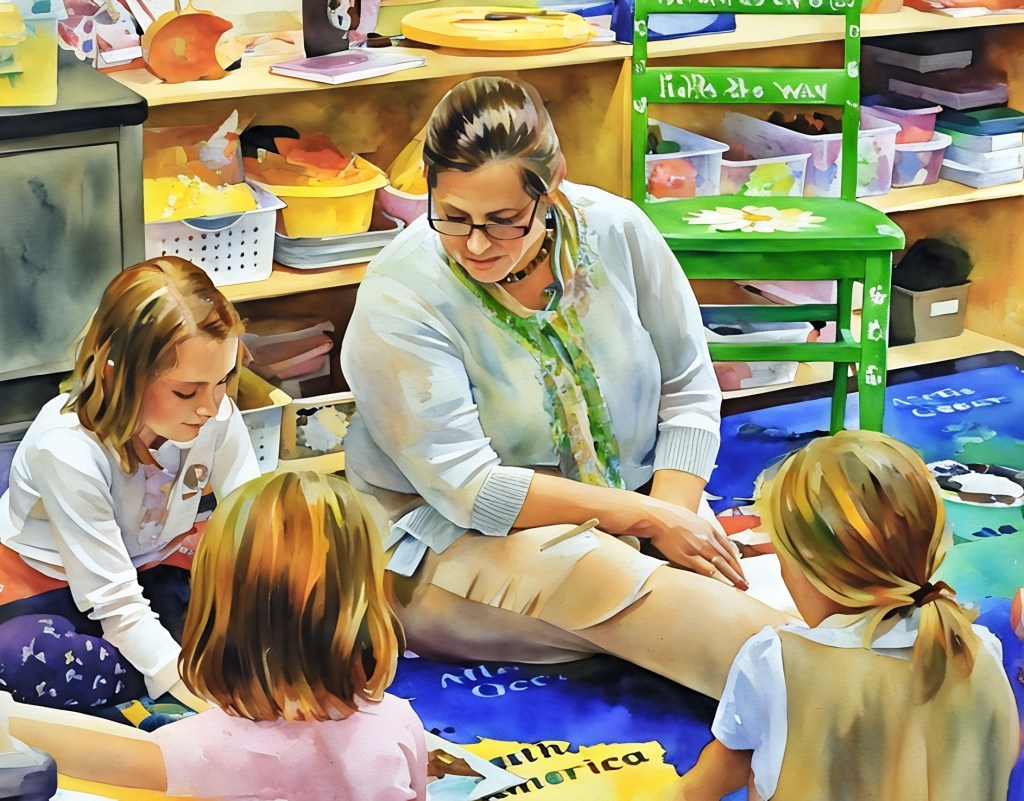
We are still getting into the school swing of things in mid-September. Kids are getting to know the classroom routines. Teachers are getting to know their students. I am circulating like a honeybee, developing a rapport with our 206 students. As a learning support coordinator, I also reach out to many parents to make sure the transition to school is going well for our students with learning differences. The beginning of school is tricky to navigate for both students and teachers, and for students with a learning difference, moving through a new school day can be stressful. I keep that top of mind when I interact with children. I stop, pause, and listen to them. I troubleshoot problems with them. I encourage them to take risks and keep on going. The one thing I know very well is school. I have been attending school, either as a student or a teacher, for 66 years. School is my happy place, and I want it to be a haven for all children.
This week, I will be giving a presentation to teachers with our school psychologist and one of our 1st-grade teachers about Strengthening Community and Building Confidence. We plan to share ideas for supporting students from Responsive Classroom and open up a conversation about how teachers build community in their classrooms. We are hoping that by sharing ideas, teachers can learn from their peers and create a wide circle of strategies to support students. Some questions we will ask our group to discuss are:
- What helps your students feel safe and welcome in the classroom?
- How do you and your students co-create classroom rules together?
- What does respect look and sound like during group work?
- Which daily routines help your students transition and feel secure?
- How do you include quiet or shy students in daily discussions?
- How do you handle disagreements or conflicts between students?
- What community circle or check-in questions work best for your age group?
- How do you celebrate student contributions and milestones?
- How do you build communication and trust with student families?
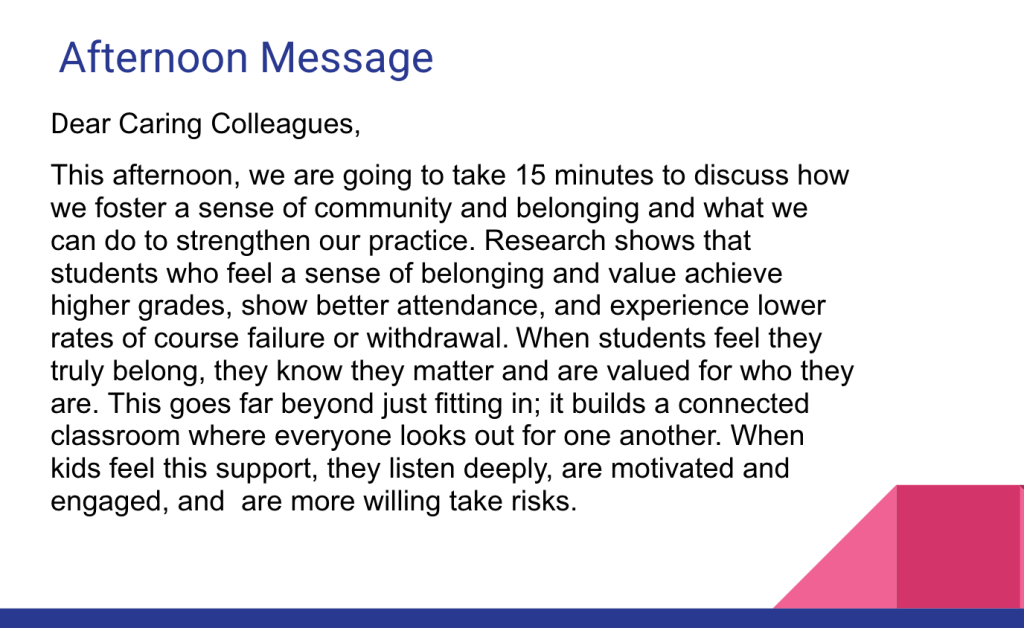
Another important component of Responsive Classroom is the Morning Message. All our classes start with a message written for the students that the children read and respond to in some way. It sets the tone for the day, builds anticipation and engagement, and lets children know the plan for the day. Below is an afternoon message I wrote to my faculty as an introduction to our community building workshop. I want to create an atmosphere of trust and collaboration so we can openly discuss ways to strengthen our community-building practices.
After classes read their Morning Message, they are ready for a Morning Meeting where students engage in activities that grow both their social interaction and executive functioning skills. The activities build listening stamina, impulse control, and working memory. They start the morning off on the right path, setting kids up for success with a firm foundation. My colleague, Jenna, does this so beautifully. She engages her 1st graders in meaningful activities that build their self-control, attention, and working memory. She does this with energy and humor every morning, and I’m in awe of her skills.
Since the beginning of the year, our school psychologist and I have spoken many times about how important teacher-student connection is to student learning. If you are not feeling emotionally confident, it will be difficult for you to listen and learn. Teachers are the front-line defense in creating a welcoming and inclusive classroom atmosphere. I was reminded of this later in the week when I was helping out in our afternoon car line. As I was waiting with a 1st grader, I made small talk about how she’s enjoying school. She said that she loved her new school. Then I asked her about her afternoon plans, and she said that she was going swimming. I asked her if she liked to swim, and she said that she did, but she did not like the teacher’s style. I smiled at such wonderful 1st-grade vocabulary, and asked her what she meant.
And without a pause, she said, “The swim teacher has a yelling style: PUT YOUR HEAD DOWN! KEEP KICKING!”
I chuckled and said, “Oh, no one learns well with a yelling style.”
Then she said, “I’m giving her one more chance,” as she hopped into her car.
As I reflect on this, I realize that’s why building relationships is so important. We have one chance to show our best selves, to be patient, kind, and understanding. Children see and hear so much; they are acutely aware of whether they are liked and accepted. I always felt that my first priority as an elementary school teacher was to make each child feel special and accepted because I knew if they trusted me, they could learn more and be successful. ‘
As we head into October, I hope we all remember to leave our own “yelling styles” at the door and embrace a style of patience, connection, and deep listening. Our students are watching, feeling, and deciding every single day if they are safe enough to take risks in our classrooms. By coming together as a faculty to share our strategies and strengthen our community, I hope to ensure that every child—especially those who navigate school a little differently—feels that unconditional acceptance. Let’s make sure that when our students give us that “one more chance,” we show them exactly why school can, and should, be their happy place.


So many telling quotes here, but these two say it all: “School is my happy place, and I want it to be a haven for all children,” and, “I hope we all remember to leave our own ‘yelling styles’ at the door and embrace a style of patience, connection, and deep listening.” I also like that your community of caring in the meeting space embraces the structures for its own, the afternoon message, for example.
LikeLiked by 1 person
I admire your enthusiasm for school. Reading your slice made me even more excited about heading back to school as a sub. Thank you for sharing so much positivity!
LikeLiked by 1 person
Word Dancer,
I love your focus on community.
This dialogue is priceless:
Strong work building community and relationships in big and small ways. I’m so happy for your students and colleagues.
LikeLiked by 1 person
Thnaks for taking time to write this and especialy capture that quick conversation filled with wisdom in the car line. “I’m giving her one more chance” made me laught…yet, so true! I am at a repsonsive classroom school and I love it! Your post reminds me why!
LikeLiked by 1 person
Responsive classrooms really help students with skills for life. More communities need to think about these processes for everyone 24/7. And the transfer – your car line conversation cemented the need!
Great post!
LikeLiked by 1 person
Dear Word Dancer,
I am struck by the numbers in this writing.
“I am circulating like a honeybee, developing a rapport with our 206 students.”
206 students!
(I have 50).
And this: “I have been attending school, either as a student or a teacher, for 66 years.”
66 years!
I did the math and I have been in school or teaching for 46 years.
46 years!
In my head I’m not 46 years old yet. 😂 (Of course I am). But when I add up the years like this, it makes me realize how long I have been in school.
In one of my circles of life, attendees don’t even make it through high school. School is not their “happy place.”
Feeling grateful I have always loved school.
Steph
LikeLiked by 1 person